Table of Contents ▼
On June 8, 2026, two scenes unfolded in parallel. In Debrecen, Hungary, EcoPro BM — a South Korean cathode producer — loaded its first commercial shipment of cathode active material (CAM) from a plant built to serve European battery makers. In Brussels, the European Commission's proposed Industrial Accelerator Act (IAA) entered trilogue negotiations, the three-way legislative process that would decide which battery components qualify as "European enough" for public procurement. One event was a factory milestone. The other was a policy threshold. Both pointed at the same choke point: Europe cannot build batteries at scale without importing the materials that go inside them — and the rules are tightening around that import dependency.
All monetary figures retain the currency of the underlying source: EUR for EU legal thresholds, European build-cost and cathode-price figures, GBP where the source is UK-based, and USD for battery-cost benchmarks. No currency conversion is applied. IAA figures reflect the proposal COM(2026) 100 final as read by law-firm analyses — not a final act.
TL;DR
The IAA and the EU-UK Trade and Cooperation Agreement (TCA) are two independent origin-locking mechanisms converging on the same product: cathode active material manufactured inside Europe. China holds 81.3% of global CAM output; Europe's domestic capacity covers less than 30% of its own demand. The compliance cost of staying outside these rules — a 10% MFN tariff on vehicles, exclusion from public procurement — is rising, while the cost advantage of Chinese-made batteries remains $41–43/kWh at the cell level.
Key Takeaways
- The IAA locks out components that are not of Union origin from public procurement; the TCA imposes a 10% MFN tariff (≈ £3,400–3,600 per vehicle) on batteries that fail origin thresholds of ≥55% vehicle / ≥70% pack / ≥65% cell ex-works value. The two systems use different origin rules and cannot be substituted for each other.
- China controls 81.3% of global CAM production (S&P Global Platts, March 2025). Europe's domestic CAM capacity covers less than 30% of its own cathode demand (2025 multi-source estimate); projected 2030 battery demand is 700–1,000 GWh.
- The cost gap is structural: pack-level pricing shows a 56% spread (China $84/kWh vs Europe ~$131/kWh, BNEF 2025); the cell-level gap is $41–43/kWh (T&E 2025). T&E projects this narrows to ~$14/kWh by 2030 only if European yield, automation and supply-chain localization catch up.
- Korean material makers are the nearest-term beneficiaries: EcoPro BM's Debrecen plant is the only Korean-operated CAM facility in Europe shipping commercial product, at 54 kt/year nameplate capacity.
- The IAA includes a cost exemption — a "disproportionality" loophole — where origin requirements can be waived if compliant products cost 25–30% more. Industry estimates put the China-Europe price differential at roughly 40%, close enough to make the exemption politically live.
My take: Two policy clocks are ticking on different schedules. The TCA runs on fixed statutory dates. The IAA runs on legislative negotiation. Both require the same physical outcome: cathode material made in Europe. The companies that build that capacity fastest will set the terms.
Scope and status
The IAA references in this article are based on proposal COM(2026) 100 final, submitted on March 4, 2026, and read through law-firm analyses (Mayer Brown, Hogan Lovells, Houthoff, Crowell). The proposal is in trilogue; the final act may differ. TCA origin rules operate under the existing legal framework; Partnership Council Decision 1/2023 freezes the TCA's product-specific rules of origin until 1 January 2032 (purely technical amendments excepted). The four EU regimes — Battery Regulation 2023/1542, CRMA 2024/1252, NZIA 2024/1735, and the proposed IAA — are independent legislative instruments with separate scopes and enforcement mechanisms.
01 Two locks, one choke point
The IAA and TCA operate through different legal foundations but converge on a single product: cathode active material. The IAA uses non-preferential rules of origin under the Union Customs Code (UCC, Reg. (EU) 952/2013). The TCA uses preferential rules of origin specific to the EU-UK agreement. The origin calculations are not interchangeable.
Both systems, however, require that battery components — and ultimately CAM — be manufactured within the EU or UK to count as originating. This convergence creates a choke point: Europe's cathode material supply chain.
Three facts define the squeeze. First, China produces 81.3% of the world's CAM. Second, Europe's installed CAM capacity covers less than 30% of its own demand (2025 multi-source estimate). Third, the two policy instruments — one procurement, one tariff — are tightening simultaneously, with no single fix that satisfies both origin frameworks.
The structural problem is not that Europe lacks battery demand. It is that the materials feeding that demand are overwhelmingly made outside the origin boundaries that the IAA and TCA are drawing.
02 The procurement lock: IAA's origin ladder
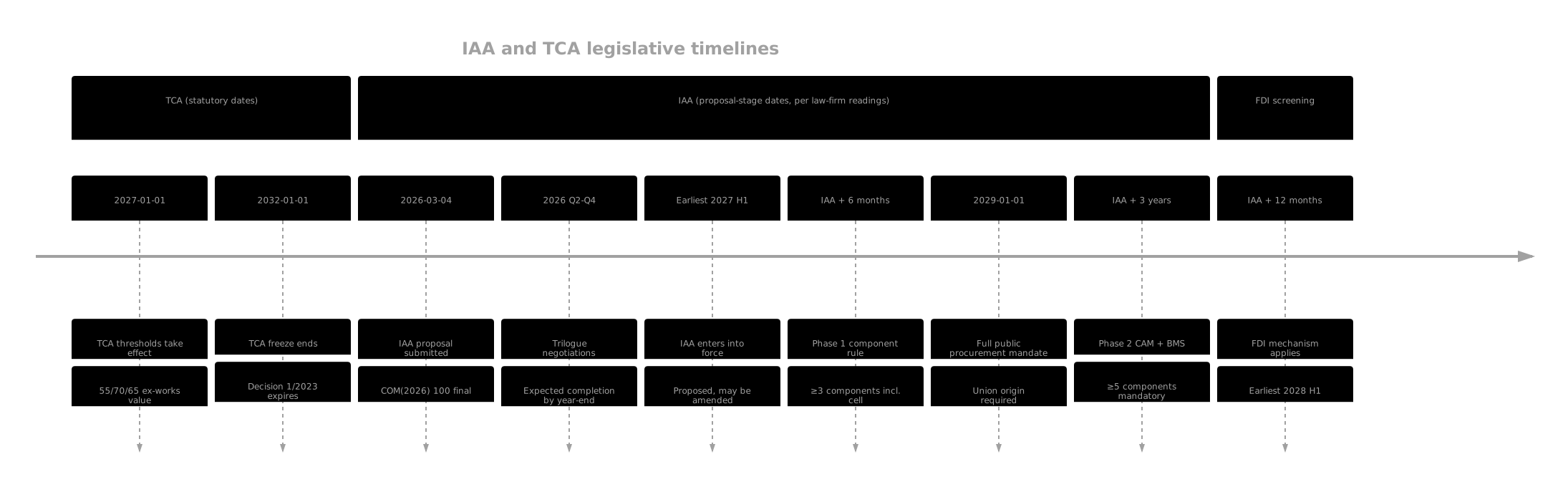
The IAA, per law-firm readings of the proposal, imposes a two-stage component requirement for battery products in public procurement. Within six months of the IAA entering into force, EV batteries must contain at least three key components of Union origin, including the cell. Within three years, the threshold rises to at least five components, including CAM and the battery management system (BMS). Battery energy storage systems (BESS) follow a parallel track: cells, BMS and at least one additional component within the three-year window.
Precursor material (pCAM) is not currently on the IAA's key-component list. This creates a narrow but significant gap: a manufacturer could source pCAM from China, perform sintering in Europe, and potentially claim the resulting CAM as Union origin.
| Category | Condition | Detail |
|---|---|---|
| Trigger | Investment value | Exceeds €100 million |
| Equity stake | ≥30% | |
| Home-country global capacity share | >40% in the relevant sector (effectively targets China) | |
| "Four-of-six" condition chain | 1. Foreign ownership cap | ≤49% |
| 2. IP licensing + exclusive ownership | License IP to EU entity; EU entity owns developed IP exclusively, including pre-FDI IP (hardest for Chinese firms) | |
| 3. EU R&D spend | ≥1% of revenue (pro-rated by stake) to EU-based R&D | |
| 4. EU-national workforce | ≥50% of employees at all levels hold EU nationality | |
| 5. EU procurement | ≥30% of inputs procured within the EU (hardest for Chinese firms) | |
| 6. Security screening | Accept security review process |
The IAA also includes a cost exemption: if compliant products cost 25–30% more than non-compliant alternatives, the origin requirement can be waived as "disproportionate." Industry estimates put the China-Europe price gap at roughly 40% — close enough to the threshold to create political room for exemptions, particularly in price-sensitive public tenders. Transport & Environment has flagged this as a "potential major loophole."
My take: The IAA's procurement lock is real but narrow. It does not touch private-market sales, which account for the majority of European EV transactions. Its power lies in signaling: OEMs that sell to public fleets will need origin-compliant battery supply chains, and they typically run one supply chain per model. Public procurement rules therefore steer the bulk of battery purchasing, even in the private market.
03 The tariff wall: TCA's frozen clock
The TCA operates on a different mechanism: preferential rules of origin that, if met, allow goods to move between the EU and UK at zero tariff. If the origin thresholds are not met, the default most-favored-nation (MFN) tariff applies — 10% on finished vehicles, translating to approximately £3,400–3,600 (~€4,000) per vehicle at current price levels.
| Product | Origin threshold (ex-works value) | Max non-originating | Non-compliance cost |
|---|---|---|---|
| Vehicle | ≥55% | ≤45% | 10% MFN tariff |
| Battery pack | ≥70% | ≤30% | 10% MFN tariff |
| Cell | ≥65% | ≤35% | 10% MFN tariff |
| 10% MFN tariff ≈ £3,400–3,600 (~€4,000) per vehicle. Thresholds are preferential rules of origin under the TCA — not interchangeable with IAA/UCC non-preferential origin. | |||
These are preferential origin rules — specific to the TCA — and must not be confused with the non-preferential UCC rules used by the IAA. A product can satisfy one system and fail the other.
The TCA's rules are frozen until 1 January 2032 by Partnership Council Decision 1/2023, with purely technical amendments excepted. No political renegotiation of the thresholds is expected before that date. The only practical lever for adjustment is a joint guidance document on CAM origin definition.
The critical ambiguity is whether sintering pCAM into CAM in Europe constitutes "substantial transformation" — the legal test for whether a product acquires the origin of the country where processing occurs. Under a strict, value-based reading, CAM made from imported pCAM may not qualify as Union origin — leaving the cell below the 65% ex-works threshold — because the majority of CAM value originated outside the EU. Under a looser reading focused on the manufacturing step, sintering in Europe could be sufficient to confer EU origin.

This ambiguity has a practical consequence: importing pCAM from China and sintering it in Europe is the most realistic near-term workaround for meeting both the TCA and IAA origin requirements. pCAM is not on the IAA's key-component list, and the sintering question remains open until formal guidance is issued.
04 Three camps, one gap
Europe's emerging CAM supply chain divides into three groups.
Korean camp. EcoPro BM operates the only Korean-operated CAM facility in Europe that has shipped commercial product — a 54 kt/year plant in Debrecen, Hungary, with first shipments on June 8, 2026. At 1,700 tonnes per GWh (mid-nickel conversion factor; 1 kt = 1,000 t), that capacity is equivalent to roughly 32 GWh of cell production. EcoPro holds a structural advantage: its plant is physically in the EU, so its product qualifies as EU origin regardless of the company's South Korean ownership. The Korea-EU FTA, applied provisionally since 2011 and in full force since 2015, lowers investment-access barriers — but does not automatically confer origin status on Korean-made products.
Japanese-European camp. Umicore's Nysa, Poland plant has been operating since 2022 at approximately 22.5 kt (~15 GWh at 1,500 t/GWh for high-nickel cathode). IONWAY, a joint venture between Umicore and Volkswagen's PowerCo subsidiary, targets 160 GWh by 2030 — a planned figure, not current capacity. BASF operates CAM production at Schwarzheide, Germany, and pCAM at Harjavalta, Finland, but has not disclosed capacity figures. Umicore has cut its battery-materials capex to €370 million for 2025–2028. Per company statements, Sumitomo Metal Mining does not plan to expand to Europe or North America.
Chinese camp. Four Chinese cathode producers are building EU-located capacity totaling approximately 150 kt, equivalent to 88 GWh at 1,700 t/GWh:
| Camp | Company & site | Capacity | Status & timeline | Key constraint |
|---|---|---|---|---|
| Korean | EcoPro BM, Debrecen (HU) | 54 kt | Operating; first shipment 2026-06-08 | EU origin; expandable to 108 kt |
| Japanese-European | Umicore, Nysa (PL) | ~22.5 kt (~15 GWh) | Operating since 2022 | Capex halved to €370M (2025–28) |
| Japanese-European | IONWAY (Umicore+PowerCo) | 160 GWh target | Planned 2030 | Not current capacity |
| Japanese-European | BASF, Schwarzheide + Harjavalta | Undisclosed | Operating | Capacity not disclosed |
| Chinese | Easpring, Finland | 60 kt NMC | 2026 H2; €824M investment | First Chinese CAM in EU |
| Chinese | Huayou Cobalt, Hungary | 25 kt | Built 2025; long-term agreements (LTAs) of 127,800 t + 88,000 t | LGES/EVE Energy downstream |
| Chinese | XTC / Orano, Dunkirk (FR) | 40 kt (expandable 80 kt) | 2028 Q4; €500M; XTC 51%/Orano 49% | French state partner (Orano) |
| Chinese | Ronbay, Konin (PL) | 25 kt | 2026 | Public information only |
| Chinese total | Four plants | ~150 kt (≈88 GWh) | 2026–2028 ramp | FDI screening applies |
| Conversion: 1,700 t/GWh (mid-nickel NMC), 1,500 t/GWh (high-nickel). BASF capacity undisclosed; not listed. IONWAY is a 2030 target, not current capacity. | ||||
Building a 20 kt CAM plant in Europe costs an estimated €250–270 million and takes 2–4 years. Plants not already under construction in 2026 will not contribute meaningful capacity before the TCA thresholds take effect in 2027 or the IAA's procurement rules bite in 2029.
Against these committed projects, Europe's projected 2030 battery demand stands at 700–1,000 GWh — a range reflecting estimates from multiple sources (S&P Global at 515 GWh, Nature Energy at 1,200 GWh, with industry consensus in between). The gap between committed CAM supply and projected demand is the central structural problem that both the IAA and TCA are trying to solve through localization mandates.
05 The cost gap that won't close
The China-Europe battery cost differential operates at three levels of the value chain.
Pack level. BNEF's 2025 survey prices Chinese battery packs at $84/kWh versus approximately $131/kWh in Europe — a spread of roughly 56%. This is a selling-price comparison, not a manufacturing-cost decomposition.
Cell level. T&E's 2025 analysis puts Chinese cell costs at approximately $57/kWh against approximately $99/kWh in Europe — a gap of $41–43/kWh. This is a manufacturing-cost figure and reflects a different level of the supply chain than the BNEF pack number. The two should not be conflated as a single data source.
2030 forecast. T&E projects the cell-level gap narrows to approximately $14/kWh (China ~$50/kWh, Europe ~$64/kWh), conditional on European manufacturers closing the yield, automation and supply-chain localization gap.
Five structural factors drive the European cost premium:
- Manufacturing yield. Chinese leaders operate above 90% yield; European lines run at around 85% — both per comparable industry data.
- Labor intensity. A Chinese CAM plant employs roughly 35 workers per GWh; a comparable European plant requires approximately 125 workers per GWh — about 3.5 times higher.
- Manufacturing wages. EU-average manufacturing hourly compensation stands at approximately $31.91 versus $5.41 in China.
- Industrial electricity. European industrial power costs approximately €0.188/kWh, versus €0.075/kWh in China — roughly 2.5 times higher.
- Supply chain depth. China's vertically integrated domestic supply chain for precursors, lithium salts and processing equipment delivers procurement cost advantages that Europe cannot replicate without localizing multiple upstream layers.
Equipment amortization runs materially higher in Europe due to greenfield CAPEX. Factor figures are drawn from the supply-chain cost assessment compiled in the underlying research.
| Level | China | Europe | Gap | Source & year |
|---|---|---|---|---|
| Pack (selling price) | $84/kWh | ~$131/kWh | +56% | BNEF 2025 |
| Cell (manufacturing cost) | ~$57/kWh | ~$99/kWh | $41–43/kWh | T&E 2025 |
| NMC 622 (nickel-cobalt-manganese) CAM | €12.8/kg | €15.4/kg | +20% | BMI/CIC energiGUNE 2024 |
| LFP CAM | €7.2/kg | €9.1/kg | +26% | BMI/CIC energiGUNE 2024 |
| Per 60 kWh EV | — | — | €2,000–2,500 | T&E / BNEF (two independent source figures) |
| 2030 cell forecast | ~$50/kWh | ~$64/kWh | ~$14/kWh | T&E forecast |
| CAM prices are 2024 data (BMI/CIC energiGUNE); BNEF and T&E figures are 2025. The per-vehicle estimate combines two independent source figures (T&E and BNEF) and should not be treated as a single methodology. | ||||
The cost penalty for European CAM is compounded by a track record of project slippage. Northvolt, once Europe's flagship battery venture, collapsed after accumulating USD 5.8 billion in debt with capacity utilization of roughly 1%. Between 2024 and 2025, 11 of 16 planned European battery projects were delayed or cancelled.
My take: T&E's 2030 convergence forecast assumes European yield and automation catch up. That assumption has not yet been validated by a single operating European CAM plant at scale. Until it is, the cost gap is a fact, not a projection.
06 OEMs and the signature gap
The European Commission's call for industry signatures in support of the IAA drew more than 1,000 suppliers — and zero automotive OEMs. The absence is structural, not incidental.
European carmakers are caught between two pressures. On one side, the 70/70 framework (a 70% EU-content target by 2030) pushes them toward local sourcing. On the other, the cost gap makes origin-compliant batteries significantly more expensive — a cost that ultimately falls on vehicle pricing and margin.
Meanwhile, Chinese automakers are moving in the opposite direction. Leapmotor builds vehicles through its Stellantis partnership. Xpeng supplies electronic architecture to Volkswagen. Renault's Shanghai-designed Twingo project embeds Chinese engineering into an EU-branded vehicle. Each of these arrangements routes Chinese-origin content into European supply chains through pathways that the IAA and TCA may or may not capture, depending on origin calculations.
The European Automobile Manufacturers' Association (ACEA) supports the IAA's core objective but warns against hollowing out Europe's industrial base: if policy pushes compliance costs up faster than domestic supply can scale, OEMs will shift more capacity overseas — accelerating, not reversing, the outflow of European manufacturing. The critique has force: European CAM capacity covers less than 30% of the region's own demand, so origin compliance for the rest means either paying the cost premium or paying the tariff.
My take: OEMs will not sign a political pledge that commits them to a supply chain that does not yet exist at competitive cost. The signature gap is a rational response to a structural mismatch between policy ambition and industrial reality.
07 Windows for three camps
Short term (2026–27). The TCA origin thresholds take effect on 1 January 2027. OEMs that cannot source origin-compliant batteries will face the 10% MFN tariff on vehicles shipped between the EU and UK. This window rewards companies that already have EU-located CAM capacity — primarily EcoPro BM and Umicore. Chinese producers with plants under construction (Huayou, Ronbay) may capture early contracts if they can demonstrate origin compliance before their competitors break ground.
Medium term (2028–29). The IAA's six-month component threshold begins after the Act enters into force (earliest 2027 H1, per law-firm readings), with full public procurement mandates from 1 January 2029, per compliance-firm readings of the proposal. FDI screening applies from 12 months after entry into force. This window pressures Chinese producers to satisfy the "four-of-six" condition chain — particularly IP exclusivity and 30% local procurement — or lose access to the public-procurement segment. Korean and European players face lower FDI friction.
Long term (2030+). The IAA's three-year rule requires CAM and BMS in the component mix. IONWAY's 160 GWh target and the Chinese camp's 88 GWh of committed capacity define the supply-side envelope. If European demand reaches 700–1,000 GWh, even full execution of all announced projects leaves a significant deficit. The 2032 TCA freeze expiry opens the possibility of renegotiated origin thresholds — but that is six years away.
08 Three risk variables
IAA amendment risk. The IAA is a proposal, not a law. The trilogue process may soften the component requirements, delay the FDI screening mechanism, or expand the cost exemption. Any of these changes would weaken the procurement lock and reduce the urgency of European CAM localization. The final text is expected by late 2026.
Korean battery-plant utilization. Korean battery-cell makers — excluding EcoPro BM, which is a cathode materials producer — held approximately 60.4% of the European battery market in 2023. By 2025, that share had fallen to roughly 30%, squeezed by CATL's expansion. Korean battery plants in Europe have operated at approximately 50% utilization for three consecutive years. If this persists, the downstream pull for European-made CAM weakens, regardless of origin rules.
Exemption survival. The IAA's cost exemption — the "disproportionality" clause — is the most politically contested element. If the 25–30% threshold is retained in the final Act, and if the China-Europe price gap remains around 40%, the exemption could become a routine workaround for price-sensitive tenders. Transport & Environment has called it a "potential major loophole." Equally, price-sensitive public buyers may lobby to keep it.
My take: The exemption is where policy ambition meets procurement reality. Removing it would force full origin compliance at higher cost. Retaining it would hollow out the localization mandate. The trilogue outcome on this single clause will do more to shape European CAM investment than any other provision.
What to watch
First, the IAA trilogue outcome and whether the final text retains the cost exemption, the "four-of-six" condition chain and the FDI screening mechanism. The legislative text expected by late 2026 will set the real rules.
Second, the TCA's 1 January 2027 origin threshold compliance: whether vehicles crossing the EU-UK border actually trigger tariff assessments, and whether any enforcement cases establish precedent on the sintering question.
Third, the joint guidance on CAM origin definition. A strict, value-based interpretation would make imported-pCAM-then-EU-sintered CAM non-originating. A substantial-transformation reading would make it qualifying. The guidance, if issued, will determine whether the pCAM import pathway is viable.
Disclosure: the author works in international sales at a cathode materials producer named in this article.